

Your Comprehensive Guide to Evaluating CRMs in the Age of AI
Updated April 21, 2026
Choosing the right Customer Relationship Management (CRM) system has always shaped a business's efficiency, customer relationships, and bottom line. What's changed in 2026 is the weight that AI now carries in that decision. Agents are automating work that used to be tedious and time-consuming, vendor pricing models are being rewritten in real time, and security expectations around customer data have climbed significantly. Selecting a CRM today means evaluating both feature sets and how a vendor's AI strategy, pricing philosophy, and security posture will hold up over the next three to five years.
This guide walks you through the criteria that matter most in 2026, how to evaluate CRM solutions against them, and what to watch for during implementation.
Understanding Your Business Needs
Before diving into CRM options, assess what your business truly requires. Consider:
- Business Goals: Are you looking to improve sales tracking, automate marketing, enhance customer service, or all of the above?
- Team Usage: Will sales, marketing, and customer service teams all use the CRM? How will it facilitate collaboration across functions?
- Current Pain Points: Identify existing challenges such as data silos, inefficient manual processes, or a lack of customer insights.
- Scalability Needs: Your CRM should grow with your business and support expanding data, customer interactions, and new integrations.
- AI Readiness: Where in your workflow could autonomous or agent-driven AI create measurable value? How clean is your current data, and what governance do you have in place to support AI-driven actions?
That last point often gets skipped. AI performs only as well as the data feeding it, and modern CRMs with strong native AI require discipline around data hygiene from day one.
Essential Features to Look For
The best CRM for your business in 2026 should include these core functionalities.
Ease of Use
- An intuitive, user-friendly interface that reduces training time and increases adoption rates
- Simple navigation and automation to minimize manual work
- Mobile-friendly access for remote teams
- AI-assisted search and natural language query, so users can ask questions of their data instead of building reports
Comprehensive Features
- Contact and account management to store all customer interactions
- Sales pipeline tracking to monitor deal progress and close more leads
- Marketing automation for email campaigns, lead nurturing, and customer segmentation
- Reporting and analytics to gain insights into customer behavior and sales performance
- AI-powered automation to recommend actions, prioritize leads, and forecast sales
AI Capabilities and Agent Architecture
This is the category that has changed most since we first published this guide, and it deserves dedicated evaluation. When assessing a CRM's AI, look at:
- Native vs. bolted-on: AI features built directly into the CRM typically perform better because they operate on full context of your customer data. Add-on AI products often duplicate work, create sync problems, and make auditability harder. G2's 2026 research on agentic AI flagged data integration depth as the single most important evaluation criterion, noting that agents without context are just expensive chatbots.
- Agent types and autonomy levels: Understand which AI functions are assistants (suggesting actions a human approves) versus agents (taking actions on their own). Both have a place, but they require different governance.
- Model flexibility: Leading platforms now let you choose or swap underlying models. HubSpot's Breeze Studio agents default to GPT-5 as of January 2026, which matters for reasoning quality in multi-step workflows.
- Transparency and auditability: Can you see exactly what the AI did, with what data, and when? HubSpot introduced Audit Cards in 2026, which provide timestamped records of every AI action including which CRM properties changed and what data informed each decision. For regulated industries like financial services, healthcare, and legal, this is a baseline requirement rather than a nice-to-have.
- Pricing model clarity: AI pricing in CRMs is currently chaotic. You will see per-user licensing, per-action credits, per-conversation fees, and outcome-based pricing in the same category. In April 2026, HubSpot moved two of its core Breeze agents to outcome-based pricing. The Customer Agent now costs $0.50 per resolved conversation, and the Prospecting Agent runs $1 per qualified lead. Salesforce currently operates three simultaneous pricing models for Agentforce, which adds significant complexity to forecasting AI costs. (Sources: MarTech & SaaStr)
- Orchestration readiness: A growing number of companies now run agents from multiple vendors side by side. G2 reports that roughly half of surveyed businesses already have agents handing off work across different platforms. Support for emerging standards like Model Context Protocol (MCP) indicates a vendor is thinking beyond their own walled garden.
Integration and Customization
- Seamless integrations with tools like email platforms, project management apps, accounting software, and marketing automation
- API support for custom integrations and workflow automation
- Customizable dashboards and reports tailored to specific business needs
- Open AI model integration, so your CRM can work with the model that best fits your use case
Onboarding and Support Resources
- Availability of training materials, webinars, and a knowledge base
- Strong customer support, including live chat, phone, and email assistance
- Dedicated onboarding support from CRM vendors or certified consulting partners
- Access to a healthy and active partner ecosystem, which becomes especially important when vendor direct support is strained
Security and Compliance
Security expectations have risen considerably in the past year. A sustained campaign of breaches targeting Salesforce customer environments through 2025 and into 2026 affected organizations including Google, Workday, Adidas, Cisco, and Coca-Cola. Salesforce attributed these to phishing, third-party integration abuse, and misconfigured Experience Cloud guest user settings rather than platform vulnerabilities, but the operational risk and breach notification burden sat with customers.
When evaluating security in 2026, look for:
- Data encryption, access controls, and multi-factor authentication
- Compliance with regulations like GDPR, HIPAA, and SOC 2
- Role-based permissions to limit access based on user roles
- Clear documentation on AI data handling, including whether your data trains shared models
- Configuration audit tooling, so overly permissive settings are surfaced before they become incidents
(Sources: SOCRadar & SecurityWeek)
Scalability & Customization
Your CRM should grow with your business. Whether you are a small startup or a large enterprise, the platform should adapt to your evolving needs. Look for:
- Flexible pricing and feature plans that allow you to scale as needed
- Custom fields, automation workflows, and integrations to tailor the system to your business processes
- Multi-user collaboration features with role-based permissions to ensure the right access for different team members
- Multi-language and multi-currency support for businesses operating in different regions
- Extensibility with third-party apps and APIs to expand functionality as your needs evolve
- AI scalability that lets you add, adjust, or retire agents as your team grows without renegotiating contracts or retraining models
Evaluating CRM Vendors
When comparing CRM providers in 2026, consider:
- User Reviews and Reputation: Check online reviews, case studies, and industry rankings. Pay particular attention to recent feedback on AI features, since the space is moving quickly and year-old reviews may describe a product that has materially changed.
- Pricing and Value: Assess whether the CRM's pricing structure aligns with your budget and needs. Model total cost of ownership across multiple scenarios, including AI usage at both low and high volumes.
- AI Pricing Stability: Ask how many times the vendor has changed AI pricing in the past 24 months. Frequent changes suggest the economics are still being figured out, which creates real budgeting risk.
- Customer Support Quality: Look for responsive service across multiple channels and clear SLAs.
- Ease of Implementation: Determine the complexity of setting up the platform and migrating existing data.
- Scalability: Ensure the CRM can handle your growth without excessive upgrades or new contracts.
- Vendor Stability: Layoffs, leadership reshuffles, and partner ecosystem health all affect the long-term reliability of your CRM choice. A multi-year CRM commitment depends on the vendor being around and focused in three years.
How HubSpot Stacks Up in an AI-First CRM Market
While some CRMs are designed for specific industries, HubSpot offers a versatile and scalable solution that meets the needs of various sectors. Its AI layer, Breeze, is embedded across Marketing, Sales, and Service Hubs rather than sold as a separate add-on. That architectural decision has practical consequences: Breeze agents operate on the same underlying CRM data your team already uses, which reduces sync issues, simplifies governance, and makes AI actions easier to audit.
For mid-market and large service businesses in law, accounting, real estate, and similar industries, HubSpot's combination of built-in AI, transparent pricing, and accessible implementation often produces faster time-to-value than heavier enterprise platforms. Larger or highly customized organizations may still benefit from Salesforce's deeper customization capabilities, though they should factor in AI pricing complexity, Data Cloud dependencies, and rising security overhead when comparing total cost of ownership.
A note on discovery as well: HubSpot released Answer Engine Optimization (AEO) as a built-in capability in Marketing Hub in 2026, scoring brand visibility across ChatGPT, Gemini, and Perplexity. For service businesses whose prospects increasingly start research inside AI tools rather than search engines, this reflects a CRM category expanding into the places buyers now live.
Comparison: HubSpot Versus Industry-Specific CRM Solutions
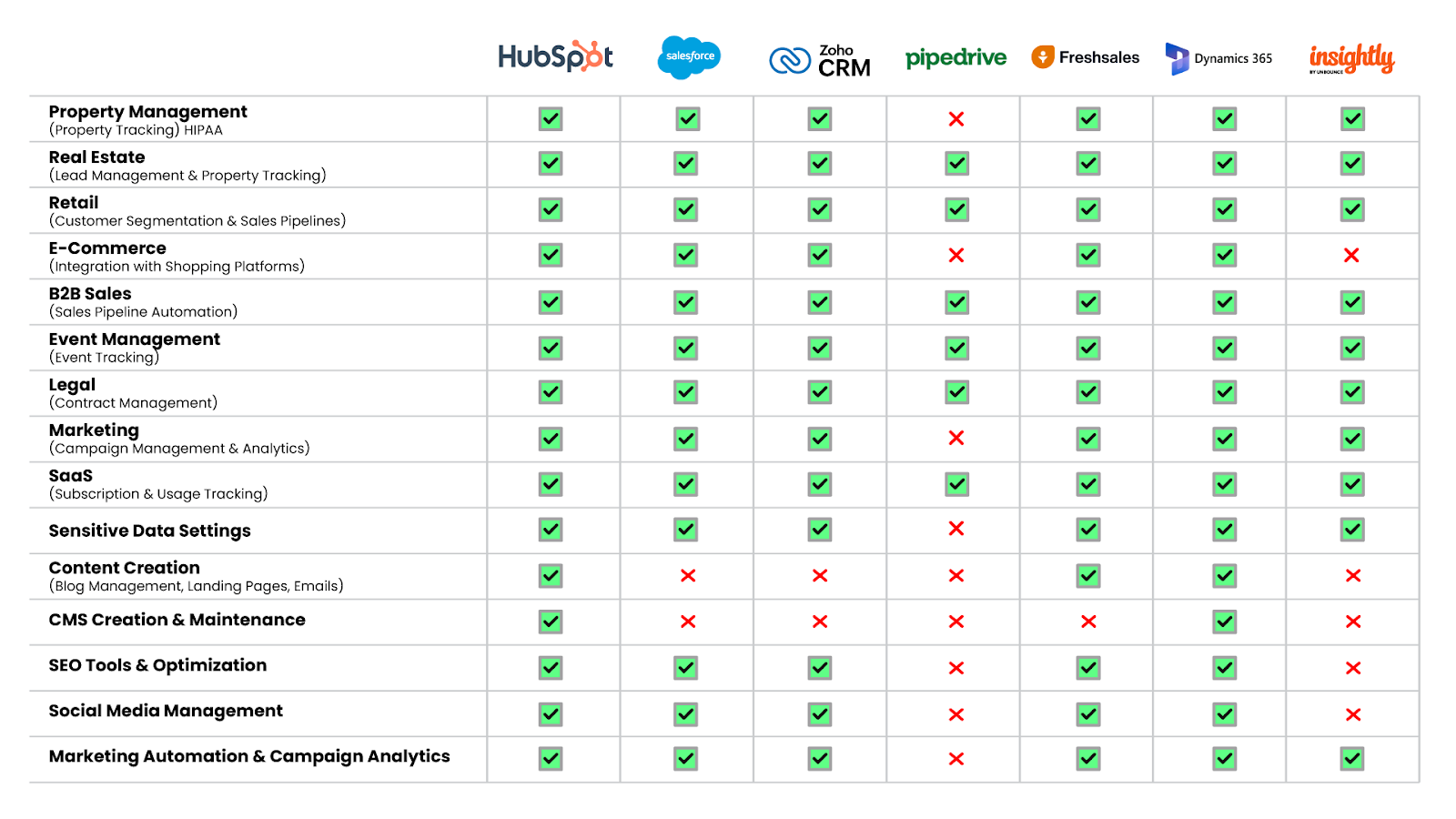
While some CRMs are designed for specific industries, HubSpot offers a versatile and scalable solution that meets the needs of various sectors. Below is a comparative table showcasing how HubSpot compares to other leading CRMs across different industries.
Implementation and Onboarding Best Practices
Selecting the right CRM is only half the battle. Successful implementation ensures your investment delivers real results. A well-planned onboarding process drives adoption, minimizes downtime, and maximizes efficiency.
Data Migration Strategy
Migrating existing customer data into a new CRM can be complex. A well-executed migration plan prevents data loss, duplication, and inconsistencies.
- Assess Data Quality: Identify outdated, duplicate, or incomplete records before migration. This step matters even more when AI agents will operate on that data after go-live.
- Map Data Fields: Ensure existing data aligns with the new CRM's structure to avoid mismatches.
- Use Automated Tools: Leverage CRM migration tools or third-party software to simplify data transfer.
- Backup Before Migration: Always create a backup to avoid permanent loss in case of errors.
Training and Adoption
Your CRM is only as effective as the people using it. Without proper training, even the best CRM can become an underutilized tool.
- Role-Based Training: Tailor training to different user groups (sales, marketing, and customer service teams) so they learn the most relevant features.
- On-Demand Learning Resources: Provide video tutorials, help documentation, and webinars for continuous learning.
- Hands-On Workshops: Encourage interactive sessions where employees can test the CRM with real data.
- AI Literacy Training: Teach users how to prompt, review, and verify AI outputs. Most CRM AI failures come from users either blindly trusting or completely ignoring the AI, rather than from the AI itself.
- Executive Buy-In: Leadership should actively endorse CRM adoption to encourage company-wide engagement.
Gradual Rollout
Instead of a full-scale launch, rolling out your CRM in phases minimizes risks and allows teams to adapt smoothly.
- Pilot Program: Start with a test group to identify issues before company-wide implementation.
- Incremental Feature Activation: Introduce CRM features progressively rather than overwhelming users with everything at once. This applies especially to AI agents, which should be enabled one workflow at a time so their behavior can be observed and tuned.
- Collect Feedback: Gather input from early adopters and refine processes before expanding usage.
AI Governance and Oversight
This is a layer that should be part of any 2026 CRM implementation:
- Define Agent Scope: Document which workflows each AI agent is authorized to act on and where human approval is required. G2's 2026 research found that agent programs maintaining human oversight were twice as likely to achieve cost savings of 75% or more compared to fully autonomous setups.
- Review Audit Logs Regularly: Whether through native tooling like HubSpot's Audit Cards or third-party monitoring, someone should be responsible for reviewing AI actions on a defined cadence.
- Establish Escalation Paths: Make it easy for team members to flag AI outputs that look wrong, so the system learns from real feedback.
(Source: G2 Learn)
Regular Monitoring and Optimization
A CRM is not a "set it and forget it" tool. It requires continuous evaluation to ensure it meets business needs.
- Monitor User Engagement: Track login rates and feature usage to identify adoption challenges.
- Analyze Performance Metrics: Review sales, marketing, and service KPIs to gauge CRM impact.
- Refine Workflows: Adjust automation rules, integrations, and customizations based on evolving business needs.
- Schedule Periodic Reviews: Conduct quarterly or annual assessments to determine if additional training or system adjustments are needed.
Final Thoughts
The right CRM can be a real lever for your business, streamlining operations, improving customer relationships, and increasing revenue. In 2026, that evaluation includes a new layer of questions about AI capability, pricing transparency, security posture, and vendor stability. By focusing on usability, comprehensive features, industry fit, and AI integration, you can make an informed decision that sets your business up for long-term success.
Book a meeting with an InboundAV CRM expert today to explore the best CRM options tailored to your business needs.

Sources
"HubSpot Moves to Outcome-Based Pricing for Some Breeze AI Agents" by Mike Pastore for MarTech
"Salesforce Now Has 3+ Pricing Models for Agentforce" by Jason Lemkin for SaaStr
"Evaluating AI Agents in 2026: What Buyers Must Know" by G2 Learn
"Developer updates for January 2026" by HubSpot Developers
"Salesforce-Related Data Breach Affecting Multiple Companies" by SOCRadar
"Hundreds of Salesforce Customers Allegedly Targeted in New Data Theft Campaign" by Eduard Kovacs for SecurityWeek
HubSpot Knowledge Base

.png)